
Redefining ERPOs: From Uniform Policy to Context-Specific Prevention
Extreme Risk Protection Orders (ERPOs) are often discussed as a singular, standardized "red flag" policy. However, this white paper reveals that ERPOs are actually highly adaptable legal instruments that function fundamentally differently depending on the state in which they are implemented. By moving beyond a one-size-fits-all perspective, stakeholders can develop more effective, tailored strategies that respect local law enforcement landscapes and existing regulatory ecosystems.


The Reality of Implementation
The core purpose of an ERPO remains consistent: providing a civil process to temporarily remove firearms from individuals in acute crisis who pose a danger to themselves or others. Yet, the efficacy of these laws is rarely determined by statutory design alone. Instead, each state’s ERPO is a unique tool woven into a specific "regulatory tapestry".
This analysis examines why some states see high adoption rates while others with similar laws do not. By evaluating four distinct state typologies—Connecticut, California, Florida, and Massachusetts—this paper identifies the hidden variables that transform these public safety tools in practice.

Key Insights at a Glance
“This detailed and well-researched comparative study of ERPO design and implementation in four states (California, Connecticut, Florida, and Massachusetts) is informative and insightful. One key takeaway is that, in a complex federal system of 50 states with deep partisan as well as urban-rural divides and over 18,000 law enforcement agencies, a one-size-fits-all approach to risk protection orders (or “Red Flag Laws”) will not work. Context matters. Florida’s approach in particular (notably, the one “red state” in this study), as analyzed by Rose and Carita, may provide a legislative policy model for other Republican-controlled states with permissive gun laws including permitless carry. This study also begs the question of whether a federal Red Flag Law would be advisable or even feasible; perhaps a more effective and realistic approach would be federal support (including funding and logistics) for state-level ERPOs.”
— Pierre M. Atlas, Ph.D.
Senior Lecturer in Public Affairs and Criminal Justice
O'Neill School of Public and Environmental Affairs, Indiana University Indianapolis
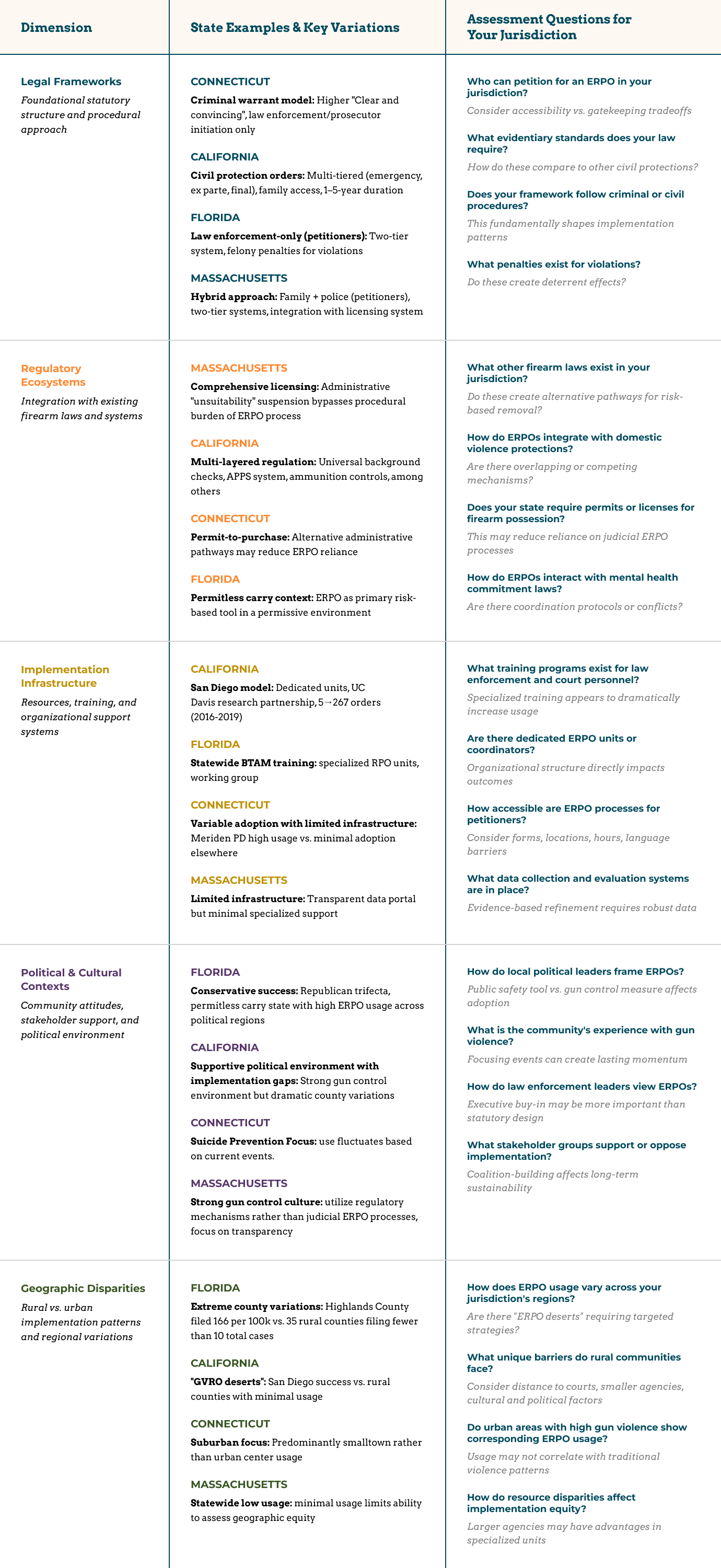
The 5-Point Framework for Success
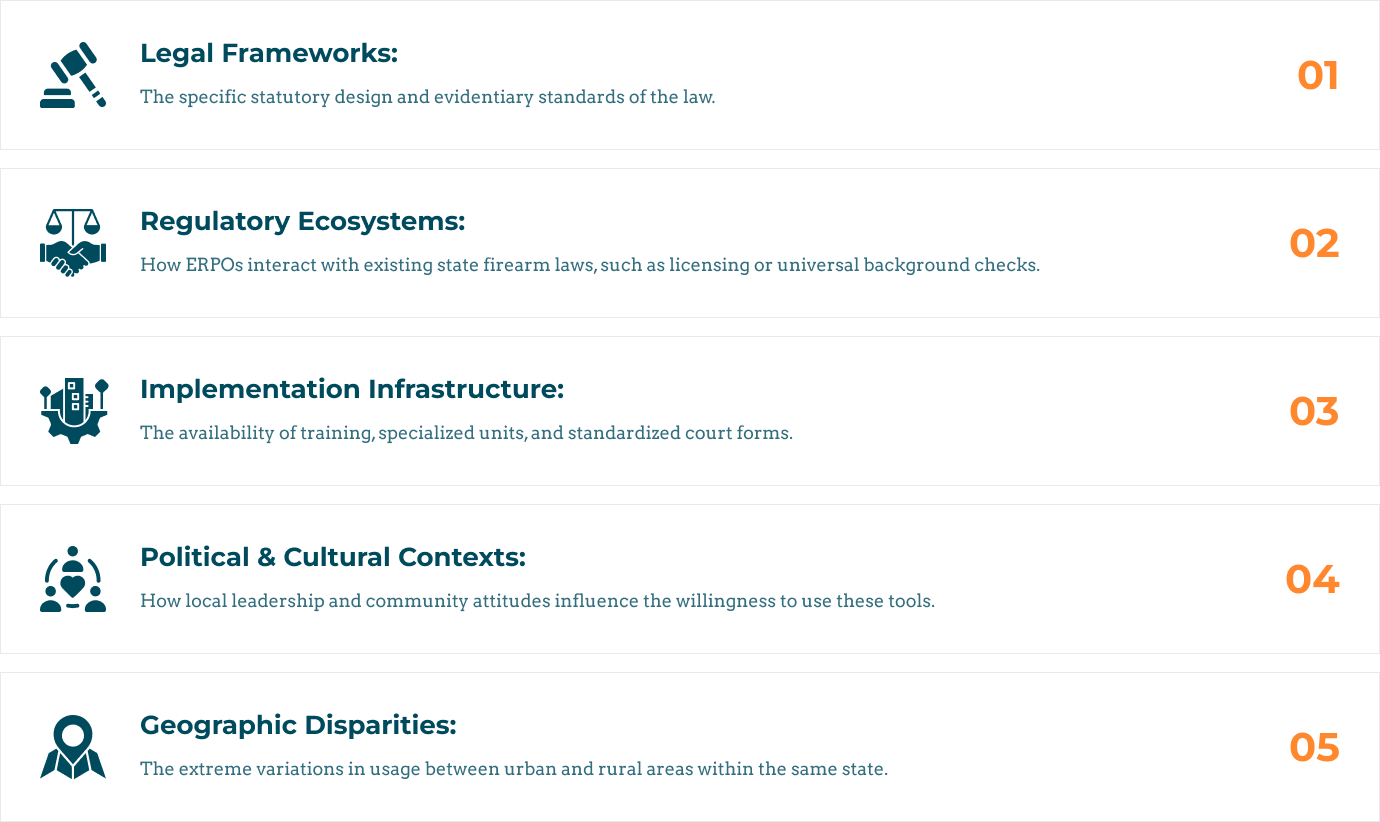
ERPO Implementation Assessment Framework
Five Critical Dimensions for Context-Specific Implementation of ERPOs
Four States, Four Models
The white paper analyzes four representative typologies to illustrate how regional variations create fundamental different legal tools